Guess too small and you’re standing in reception with a truck full of furniture and nowhere to put the last few boxes. Guess too big and you’re quietly paying for empty floor space every month. Sizing a storage unit correctly comes down to a few simple questions rather than guesswork — whether you’re renting in Te Aro and bridging the gap between two leases, or clearing out a family home in Khandallah before a renovation.
This guide breaks down what actually fits in each unit size, how renters and homeowners tend to differ in what they need, and how to avoid the two most common (and costly) sizing mistakes.
Key Takeaways
- Units run from small lockers (1-2m²) up to large 18m² (6m x 3m) mini warehouses — there’s a size for one box of documents right up to a full house move
- Renters typically need lockers to small units for bridging gaps between flats or storing off-season gear
- Homeowners moving a full house usually need medium to large units, while a garage clear-out or renovation often needs XL
- Rough rule of thumb: each furnished room adds roughly 2-3m² of storage needed
- Sizing up slightly costs less than sizing up twice — a too-small unit often means a second unit or another truck trip
- StoreStuff lets you swap sizes anytime with credit transferring across, so getting it slightly wrong isn’t a costly mistake
Storage Unit Sizes at a Glance
| Unit size | Roughly fits | Best for |
|---|---|---|
| Locker (1-2m²) | A few boxes, luggage, files, seasonal gear | Students, document archives, luggage storage |
| Small (3-4m²) | Studio or 1-bedroom flat contents | Renters between leases, small households |
| Medium (5-8m²) | 2-3 bedroom home contents | Growing families, mid-size moves |
| Large (9-12m²) | 3-4 bedroom house contents | Full house moves, major renovations |
| XL (13-18m²) | 4+ bedroom house, garage, vehicle | Big families, business stock, car or boat storage |
These bands are a starting point, not a strict rule — how densely you pack can shift you up or down a size. Still unsure? StoreStuff’s Online Space Estimator gives a quick starting figure based on what you’re storing.
Renters: How Much Space Between Flats?
Wellington’s rental market moves fast, and changeovers rarely line up neatly. For renters in flat-heavy suburbs like Te Aro, Newtown and Mount Cook, a locker or small unit is usually enough — a bedroom’s worth of boxes, a bike, seasonal clothing, and a piece of furniture you’d rather not sell and rebuy. Storing a full studio or one-bedroom flat typically needs a small 3-4m² unit; only storing your share of a shared flat usually keeps you in locker territory.
Homeowners: Sizing for a Move, Reno or Garage Overflow
Homeowners tend to need more room, and the reason isn’t always “more furniture” — it’s years of accumulated garage and shed contents that never got sorted. A family home in Khandallah or Johnsonville mid-renovation typically needs a large unit for room furniture alone, before the garage even comes into it.
For a full house move, size roughly to bedroom count: a 3-bedroom home usually needs large (9-12m²), while a 4+ bedroom home with garage overflow is often better suited to XL (13-18m²). Downsizing from a family home in Eastbourne or Naenae into something smaller is one of the most common reasons for an XL unit — not because everything’s being kept forever, but because there’s rarely time to sort it all before settlement day.
Quick Rule of Thumb by Room
Walking mentally through your house, this rough guide translates rooms into square metres:
- Bedroom (bed, wardrobe, drawers, boxes): roughly 2-3m²
- Living room (couch, TV unit, coffee table, bookshelf): roughly 3-4m²
- Kitchen/dining (table, chairs, appliances, boxed items): roughly 2-3m²
- Garage or shed contents: highly variable, budget 4-6m² minimum beyond a bike and some tools
Add these up loosely rather than treating them as exact — the same 3-bedroom house might sit in large or push into XL depending on how full the garage is.
When in Doubt, Size Up Slightly
The two sizing mistakes cost differently. Sizing up slightly means a bit of empty floor space and a marginally higher rate. Sizing down means arriving on move-in day, realising it won’t fit, and either booking a second unit or making another truck trip — usually on the day you least want extra hassle. If you’re torn between two sizes, the safer call is the bigger one. And because unit swaps here carry your existing credit across, correcting a too-small unit later doesn’t cost what you’ve already paid — it just moves with you.
Why Sizing is Easy at StoreStuff
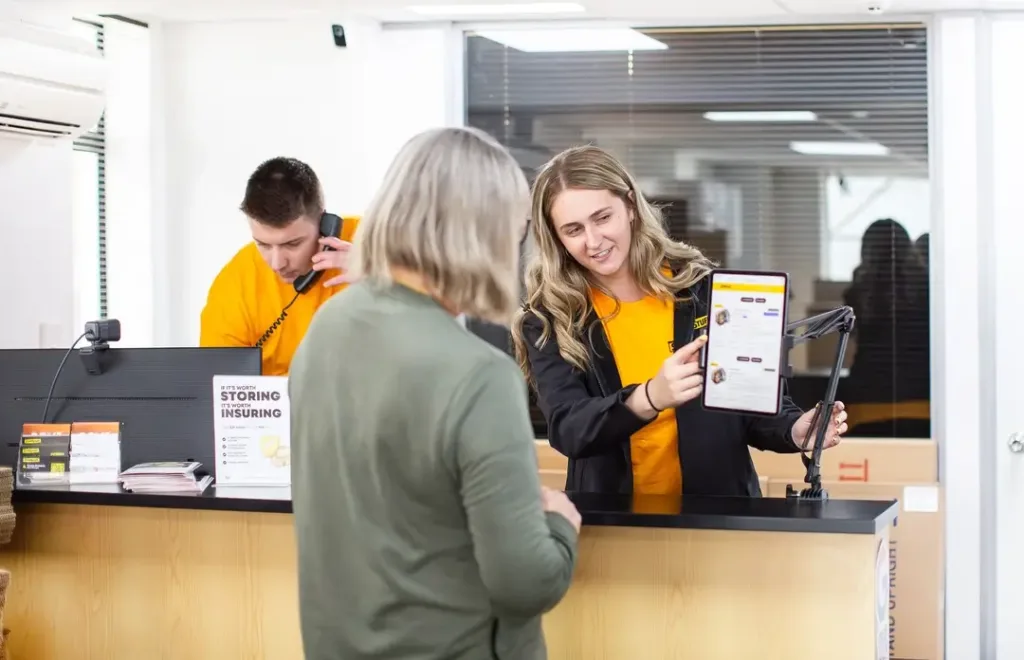
The team is on-site six days a week and happy to talk through what you’re storing over the phone or in person, then show you the actual unit before you commit — no algorithm, just people who’ve seen a few thousand household moves. If your needs change after booking, upgrading is simple: any credit on your existing unit transfers straight to the larger one. There’s no lock-in contract, and every unit over 2m² includes free use of the move-in truck, so getting everything across doesn’t depend on guessing the size exactly right first time.
Ready to Find Your Right-Sized Unit?
Start with the bands above as a rough guide, then get a second opinion before you commit. First, try the Online Space Estimator for a quick starting point. Second, call 04 260 2138 or email lowerhutt@storestuff.co.nz to talk through your situation. Third, come and see the Petone facility in person — seeing the actual dimensions beats guessing from a chart every time.
Whether it’s a single locker or an 18m² unit for a full house move, StoreStuff has the range to match — and the flexibility to fix it if you get it wrong the first time.
Frequently Asked Questions
What size storage unit do I need for a 1-bedroom flat? Most 1-bedroom or studio contents fit a small 3-4m² unit — bed, couch, small table, wardrobe boxes and general belongings. Only storing part of a shared flat’s contents, a locker may be enough.
What size storage unit do I need for a 3-4 bedroom house? A 3-bedroom house typically needs a large 9-12m² unit for a full move. A 4+ bedroom home with a garage or shed’s worth of extra gear usually needs XL (13-18m²) to fit everything without cramming.
Can I change my storage unit size after booking? Yes. If your unit turns out too small or too large, you can swap sizes at any stage, with any credit on your existing unit transferring straight across — you’re not starting from scratch or losing what you’ve already paid.
What’s the smallest storage option available? Lockers start from around 1m², suited to a handful of boxes, documents, luggage or seasonal items — a popular choice for students and anyone needing a small amount of secure, dry space rather than a full unit.
Is it cheaper to get a slightly bigger unit than I need? Not month-to-month, but usually cheaper overall. A too-small unit often means a second unit or an extra truck trip — both cost more than the modest difference between one size and the next up.
Source Links
- Consumer NZ — Self Storage Guide — https://www.consumer.org.nz/articles/self-storage
- Self Storage Association of Australasia — https://www.ssaa.asn.au
About StoreStuff Self Storage Wellington
StoreStuff Self Storage offers premium indoor self-storage solutions across the Wellington region from our centrally located Petone facility. Serving Wellington CBD, the Hutt Valley, and all Greater Wellington suburbs, we offer everything from 1m² lockers to 18m² mini warehouses, with the flexibility to swap sizes anytime. Established in 2023, StoreStuff embodies our tagline: “It’s Self Storage, The Kiwi Way.”